Showing posts with label book recommendation. Show all posts

Saturday, March 7, 2026

THE ENEMY AT THE GATE by ANDREW WHEATCROFT on THE SIEGE OF VIENNA IN 1683

HIGHLY RECOMMENDED!

I have a confession to make. I didn't read this book cover to cover as I usually do before posting. But I can say that all the positive reviews are right. It really is riveting!  I just had one interruption after another as I tried to read it and I think this book takes some deep concentration to grasp the details of battles and all the various historical characters. But, just because this isn't the best time for me to read it, doesn't mean you can't. I think it's one for the shelf of anyone interested in the history of Hungary and thereabouts.

Author Wheatcroft assures us that both sides claimed victories and both war-craft and heroism are emphasized. It is rich with descriptions of the Ottoman's tent-cities, the taking of slaves - those from Royal Hungary were especially prized. This battle was a pivotal one because, after it, the Ottoman Turks were not able to further expand their empire into Europe. It was the first time that the Holy Roman Empire (Holy Roman Emperor Leopold I) and the Polish Lithuanian Commonweath, under the command of King John III Sobieski together went against the Ottoman Turks (Grand Vizier Merzifonlu Kara Mustafa Pasha)and their empire. To this day, when someone tells me that they consider the Poles and the Hungarians to be 'friends' I know that idea comes from their collaboration in war.

***
As you may have seen, some of the earliest heraldic crests that identify noble families have images of success against the Turks. The armies that went against the Turks were quite outnumbered. There was tremendous sacrifice of life.  It was a war for dominance, but not just for land, but also for religion. 

I am so weary of violence, destruction, war, on this planet. Maybe it's simply a fact of life on earth and will never end. Like plagues have, the loss of men who went to war dramatically allowed the marriage or remarriage between classes of people and inheritance.

C 2026 Magyar American BlogSpot  Book Recommendation  
All Rights Reserved including Internet and International Rights

Thursday, February 17, 2022

BEST NEW POLISH COOKBOOK! FRESH FROM POLAND by MICHAL KORKOSZ (It's Vegetarian!)

We're not opposed to trying new recipes or other ethnicity's cuisine are we?  

Now that libraries are reopened in my area, I went wild borrowing new books.  I have a stack of fifteen from two different libraries and this old book worm is slowly making her way through them. On the new book shelf I found this cookbook and a a couple others that focus on Polish cooking.  This one is the best.

Perhaps I needed to be awakened to the possibilities of pierogi. 

 These recipes all have a little twist to them, a little update, and Pierogi with Sauerkraut, Mushrooms, and Candied Orange Zest which is suggested for the Christmas holidays but too bad that's past, is delicious. What about goat cheese, spinach, and roasted almonds as a filling?  Oh I do so want to try several of the recipes and I'm not vegetarian!


Wednesday, October 25, 2017

WALKING IN HUNGARY : MAGYAR AMERICAN BOOK REVIEW


Downloaded this one as an e-book gratis my public library and an app called Overdrive.  Have you ever wanted to walk where the roads don't go? Pictures throughout, one gets the feel of the Hungarian rolling countryside, ruins, and other geographical and historical features you may want to see the slow way. A lovely book with insider tips such as how trails are marked and which bus lines are best to a particular location. Of particular interest to me the Hungarian "highlands" and Castle Fuzer.


Saturday, September 16, 2017

REVISITING A SINGLE YELLOW ROSE by ANNA KOCZAK


A couple years ago, I posted about this book.  Here is a scene from page 38 of the paperback that took place 70 YEARS AGO in the Chapter September-October 1947.  Sadly too many Hungarians and Hungarian-Americans remember these times because of their personal losses.

...Koros opened a document and handed it to Father. "It's your turn, Gyula," Koros said flatly, The paper bore the stamp of the government.  Like those before him, my father was being asked to sign away his land.  It was bad enough that this man treated others in the town with contempt, but that he could be so cold-hearted to someone who was part of his extended family shocked me.

"And if I don't," my father asked.

Waving his hand at the policemen, he said, "You will."

"Sign it, Gyula," my mother said, a catch in her throat.  "The land is not worth the price we'll pay if you don't."

At age sixty two, with the flourish of a pen, my father lost most of his land, his horses, his vineyards, his friends, his fruit trees, everything he'd worked for over a lifetime.  My mother too lost what she loved.  And so did all of us.

Father dropped the document on the ground. "It's all yours, Feri." Then in a calm voice and looking him in the eye, he added, "Men like you disgust me."

Tears tugged at my eyes.  I was furious and already imagined strangers cultivating and harvesting our land and the land of our neighbors.  How could this man so casually destroy people's lives.  Father was right.  He was disgusting...


I recently read this book over again.  The twists and turns and tensions build, but I'm picking up on some things I didn't the first time around.  Not only were Anna Toth's favorite color of roses yellow, but red roses were hated because they were associated with the Communists.

Saturday, September 2, 2017

THE COUNTESS by REBECCA JOHNS


THE COUNTESS, a fictive novel which tells the story of Countess Elizabeth Bathory, who is supposed to have been the serial killer of hundreds of servant girls.  (I still think the numbers are exaggerated but even a dozen or two is extreme.)  Rebecca John's book was truly engaging. Reading his book and the Urbarium about the same time, though the events in this book took place more than a hundred years earlier, helped me understand better what life was for Hungarian women of the high nobility at the time when Bathory lived. Women like those married to the men who were counted in that census. 

Usually arranged to be married, never the less they still had poor relatives. They were often sent these poor relatives to work for them, to be educated a bit by working for the estate, or married off.  In this book the servant girls are often sexual before marriage, depicted as eagerly seducible, even promiscuous, and maybe that was a fact of class difference, or perhaps that is only in the viewpoint of a woman whose marriage is arranged,  but it is one of the reasons they are punished by her. 

Clearly increasingly sadistic, but with faithful servants also cooperating or punishing the girls themselves, the Countess thinks that it is completely in her right to be so punishing, but even the high nobility has its limits about what punishment is, and the torture and death of a servant, while not unheard of, is still not common. 
 
How long have the rumors been flying? 

How many good excuses, and bad ones, does the Countess have before she is walled up in a room, where she lives a couple years until she dies, visited only by a confessor, who can't actually get any sorrow out of her?

Is she a sympathetic character?  In my opinion, in some ways, she is. 


A countess of wealth had to be excellent at managing an estate and often spent months at a time - sometimes years - without seeing her husband and actually having a relationship with him.  The shifts of allegiances and power, at a time when Croation nobles are marrying with Hungarians and some Hungarians in Transylvania have a different notion of who should be ruling what, mean that a man really must be ready to battle physically if politicking isn't working in his favor.

There was a lot of research put into this book, so if you've been reading the Urbarium, or perhaps doing some personal family history or genealogy research, some of the noble surnames will sound familiar to you. Bathory's arranged marriage is history, as are the marriages of other nobles mentioned in the book.   

After the death of her husband, his best friend who had agreed to look in on her, did, but he also slept with her and then didn't marry her, choosing instead a much younger woman without a dowry to her name.  She is terribly embarrassed to have to beg money that was loaned by her husband to give her daughter a dowry and everyone suspects or knows that she has had this involvement and that the man will show off his new, nubile bride at the wedding.  Perhaps it's her husband's best friend who also, finally, puts a stop to her violent aberrant behavior.

C 2017  Magyar American BlogSpot  All Rights Reserved.

Sunday, October 16, 2016

THE SILK ROAD by VALERIE HANSEN : MAGYAR AMERICAN BOOK REVIEW

A NEW HISTORY WITH DOCUMENTS
WITH COVERAGE OF THE MONGOLS and MARCO POLO
C2017 Oxford University Press
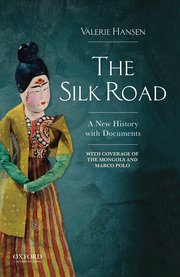


I confess, I saw that this book, which came from the history - genealogy department of my library, had pictures of artifacts (including clay monkeys from Yotkan that are sexually explicit and probably used to enhance fertility), a burial called the Niya coffin, in which a man who died of knife wounds and his smothered wife, dating 3rd or 4th century CE, were buried together and the garments they wore survive in color,  an ancient Buddhist Stupa (that barely looks like Buddha), and other items that are from archeological digs, and I wanted to read it from cover to cover.  It has translated poetry, letters, Hebrew prayers, and is also about religion, the spread of Buddhism for instance.  There pictures of silk fabric fragments that help you understand the designs that people were able to produce hundreds of years ago. 


I will probably have to order this book back in to do so; I found myself unable to concentrate and give it the time it deserves.  I decided to focus on the routes called "the grasslands" . one of which went from Europe (Vienna) and seems to go through upper Hungary or lower Poland on today's map.


In college I took a literature course that focused on Crusades era travelers including Marco Polo, John of Plano (also called John Plano Carpini0, and other very early manuscripts (that were in translation to English). I was also aware that the travels of Marco Polo are suspect.   There are a lot of maps in this book and on page 392 there are several routes on a grasslands map, including those used by William of Rubruck, Rabban Sauma, Ibn Buttuta (another person whose writing we read in the course), as well as Marco.  Rabban left France, further west. 


The grassland routes went through Eurasia into the Mongol empire that had been unified in 1206 by Genghis (Chinggis is his Mongolian name) and this way the travelers bypassed the mountains and the deserts to the south.  (Sounds like the way to go to me.) 


On page 394 it says that  after Genghis died it was his son, Ogodei, who  led armies to victory over Georgia, Armenia, Iran, Kiev, and Hungary, creating the largest continuous empire in world history.  (Other Silk Road routes took travelers through India as well.)  This expansion took place during the era of Christianity called the second crusades which began in 1100 when the pope called upon European Christians to travel to the Holy land to capture Jerusalem from the Islamic rulers.  According to author Valerie Hansen, the Pope hoped an alliance with the Mongols would be helpful.


Now what surprised me was learning that THERE WERE ALREADY CHRISTIAN MONGOLS!  "The East Syriac Christan Church, based in Iraq, had sent Uighur speaking missionaries into Mongol territories before 1200, and they had one converts, particularly among the Ongut tribe, and some Mongols from the Kereyit and Naiman tribes converted after 1206."  Some of Ghengis' descendants married these Mongol Christians!  "The Europeans also believed that a mythic Christian ruler named Prester John ruled somewhere in Asia..."  (I've heard of Prester John before, and I believe that he remains a mystery and may have always been a myth.)


This was also the era in which SAINT FRANCIS OF ASSISI started the Franciscan order!


Somehow, knowing that brought the whole Mongol conquest and the founding of Hungary into historical perspective of me, and didn't seem so long ago anymore.


Pope Innocent IV sent John of Plano Carpini  (Giovanni del Plan di Carpini) to the khans court in Mongolia, or tried to...  Carpini carried a letter.  I recall from my college class that this man was portly, his bones ached, he was about 60, and the trip was hard on him.  He spoke Latin and French only, so he took along a man named Benedict who knew Russian and Polish...  I suppose that must have helped for some of the trip!  On the way the letter was translated at the camp of Batu, a Mongol prince.


The translation was from Latin to Russian,  Russian to Persian, and Persian to Mongolian.  (Page 396)  Who knows how the communication had altered?


Carpini and his companion covered 3000 miles in three and a half months, and I don't want to ruin this rich story for you, but it would be some time before they were able to deliver that letter.


It wouldn't be called the Silk Road if there were not a lot of silk and other beautiful fabrics worn, made into tents, and used for trade.  Gifts were expected.  Gold and Silver were in abundance through plunder.  The merchants they encountered included Austrians, Poles, Greeks...  (So, while people back home feared the Mongols, the merchants apparently knew enough about their culture to be able to trade with them.)


I'll leave my brief version of just one of the amazing stories in this book here.   Whenever I read about the Mongols and the Silk Road, the merchants moving along the routes, I often think about what we are learning about the migration of our DNA through thousands of years. 


So, though I have yet to read this book cover to cover, I do recommend it highly!


C 2016  All Rights Reserved  Magyar American Blogspot

Tuesday, August 23, 2016

POLISH, CZECH and SLOVAK GENEALOGY by LIZA A. ALZO

POLISH CZECH and SLOVAK GENEALOGY
 by  Lisa A. Alzo


Since so many Hungarians have united in marriage with people from Polish, Czech, and/or Slovak heritage, both in Europe and in the United States, I wanted to read this book, which is very informative and has loads of information, some of which even the very experienced genealogy researcher might find helpful.


For instance,  On pages 134-135  we learn that there was such a thing as PARISH CENSUS and POPULATION REGISTERS.  


A parish census is different than the usual birth, marriage, and death records because it is a census of all the people in the parish, even if maybe that year they had no sacramental going on. 


A population register is different because in some European countries a person was required to register their PLACE OF RESIDENCE, and these records can give you the person's name, birthdate, and birthplace, as well as family relationship, parents' name and marital status.


There are extensive website and publication lists in the back of the book.  There are also lists of commonly encountered words in Polish, Czech, or Slovak when you're trying to read typical genealogy records.  There's an example of a Polish CIVIL Marriage record which was brimming with detail (once translated) from 1863; It mentioned  the age and occupations of the witnesses as well as their marital status, that the marriage was religious, and that the newly-weds stated that there was NO PRENUPTUAL AGREEMENT BETWEEN THEM!


Although the author finds forums valuable, I never have.  I've wasted a lot of time on them reading pleas from people who expect to find relatives, not through genealogy, but because they are social networking, and these people rarely give the kind of details that would convince the researcher that there's a connection.  They think their surname, which may be difficult to spell or pronounce is so unusual or that there is a village in common is all someone needs to know.  I also wonder at the personal information being given to the world that is and should be private in this pursuit.  Finally, once or twice I read something on a forum that triggered some interest, but by the time I had my research to the point where I was more convinced of a connection, that person's contact link or e-mail was no longer good, or I never heard back from them anyway. Sometimes I think forums are just full of inexpert or lazy people.


All in all, this is book worthwhile your time!


C 2016  Magyar American BlogSpot  All Rights Reserved including Internet and International Rights

Sunday, August 14, 2016

MONGOLIAN WOMEN HAD IT GOOD COMPARED TO MOST MEDIEVAL WOMEN

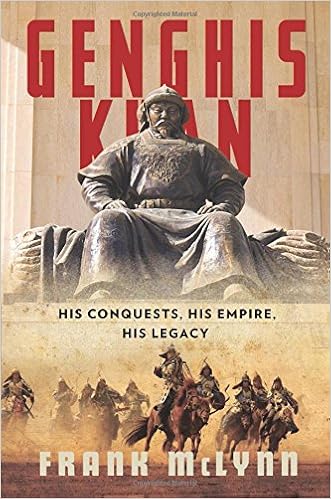
Pages 169-174  From GENGHIS KHAN  His Conquests  His Empire  His Legacy by Frank McLynn.

The Mongols were polygamous (taking many wives) and polygynous (taking many concubines) but the children of the chief wife were the ones who could be considered for the succession when their father died.

Genghis Khan's troops killed half the population of Hungary in the 1241 era, and one of the Mongol warriors favorite activities was raping the women, often in front of their father or husband.  So what was life like for a MONGOLIAN WOMAN?  Well, it turns out that compared to most medieval women, they had better status.  This didn't mean they weren't treated as chattel, but consider; Genghis OUTLAWED RAPE.  In the past only women were executed for adultery but now both men and women suffered the same punishment, "unless they were rich enough to buy themselves out of the predicament."  Women could also decided if they wanted to be married and divorce became possible for them as it was by mutual consent.  They did not expect a woman to be a virgin when she married and there was no stigma about having children before marriage or divorcing with children or having been married before.  What this means is that if a couple could deal with their differences mutually and peaceably, the consequences were not great.

For the chief and high status men, marriage was not a personal decision so much as a community decision.  Marriage was also considered to be eternal.  Genghis was concerned about inbreeding but his precautions were not always followed. (It's possible that shorter lifespans were a result.)

In their nomadic and hunter-gatherer society, unlike the more European Agricultural societies, women and men performed many of the same or similar jobs, so there wasn't the divide of roles or "men's work," seen elsewhere.  She was kept busy with household and other tasks.  She was expected to know how to drive a large wagon, some with as many as 20 horses.   "One woman would often be expected to drive as many as thirty interconnected wagons,; seven women would often be needed to transport a single oligarch's possessions, for one of these elaborate dwellings, when transported could fill over two hundred wagons; moreover, a single noble with multiple wives might have several such portable palaces." (171)  Sometimes the woman had to figure out how to load the horses - and camels - so that everything was weight distributed.

Wise old women were prized for their wisdom and thought that some women had magical powers.  Women did not have their feet bound as women did in China, nor did they wear clothing that prevented than from moving or seeing freely, such as Person chadors or Arabic burqas.  They could even be regents or the realm or advisors.  So in the 13th century there were many notable Mongol women.  All this upset visitors from the Christian and Muslim faiths, and Buddhism and Confucianism when adopted from China, also reduced the role of women.

Overall, Genghis was considered a very pragmatic man and a genius about human nature.  All the changes he made so that women would have a greater role and more respect than they had before were probably made to make life easier for the entire tribe.

C 2016  Book Excerpt/Review  Magyar American BlogSpot  All Rights Reserved

Saturday, August 6, 2016

MONGOLIAN INVADERS KILLED HALF THE HUNGARIAN POPULATION - GENGIS KHAN and HIS TROOPS RAPED WOMEN

  After I learned that the Mongolian Invaders had killed half the Hungarian population (or you could say half the population of peoples living in the land known to us as Hungary) I wanted to know more.  I'm one of those people of Hungarian descent who has some Asian features, and I've already wrapped my mind around the probability that some ancestor of mine was raped and that these features have been brought forward though the intermarriage in Hungary of others with a similar genetic heritage. Or could it be instead that these features are not Mongolian, but of the original Magyars?

Author Frank McLynn did a great job of explaining their culture, their world view, their expertise, and their military strategy, blow by blow. But I was distracted and I decided to focus only on the chapter about the Invasion and Devastation in then-Hungary.

Batu and Subedei where the men who closed in on Hungary, then a nation of around 2 million people that went from Transylvanian Alps to modern Croatia, and the Pannanonian Plain was their base for military operations.  This was the era around 1236 - 1242, a time of Crusades, and a time when Hungary had been through a number of rulers, had a relationship with the Vatican which had it's own army, and was thought to have its own impressive and imposing military force, capable of defeating any European country.

However, the Mongols were greatly feared and there were also issues between the Cumans and the Hungarians so they proved not to be the hoped for allies.  Subedei was a genius strategist who decided to use three armies to invade the land and have them all unite at the Danube. His brother Shiban covered the northern area between Poland and Moravia.  Quadan went south-easterly between the eastern Carpathians and the Dniester river, and the main army under Batu went through the Verecke Pass and the upper Tisza Valley. 

There were few good roads in Hungary and the landscape dotted with villages proved to be mostly indefensible.  The Mongols played the game of allowing a troop to think they were gone or had won and then would come back to massacre them.  Notable men including Archbishops and Bishops and those important in the politics and rule of the region also fought in battle and died.  Ethnic Poles and Germans living in Hungary fought too.  The Mongols continued a systematic program of atrocities and exterminating the people.  They also enjoyed mass rape, especially doing so in front of the woman's father or husbands.

Famine and disease, especially the sicknesses transmitted from having so many dead corpses around killed off many more.  The farmers were unable to farm and have crops in for a year after the Mongols left, there was death by starvation.

Infighting within the Mongol Empire was also occurring, as so many troops had left there to fight,  and by 1279 it was divided.  The Golden Horde of China's Quabilai's dominated Russia for another two hundred years.  Chagatai Khanate (a place) in central Asia dominated parts of today's Mongolia, Russia, India, China, Pakistan, Afghanistan, Turkmenistan, Uzbekistan, Tajikistan, and Kazakhstan.  Then an area that included eastern Turkey, Iran, Iraq, Azerbaijan, Georgia, Armenia, western Afghanistan, south-western Pakistan and parts of modern Turkmenistan called the (place) Iklhanate.

There seems to have been no time in all this warfare for a nice Mongolian boy to fall in love with a nice Hungarian girl and get married, so there is a very good chance that if you have facial or other bodily characteristics that are most often "Asian," rape is likely the way those characteristics came into the Hungarian (or Polish, Slovak, German, or other ethnic population.)  Either way, if you have Hungarian heritage someone in your lineage survived the carnage, at least long enough to have a child.

Learning that easily half a million to one million were killed by the Mongolians in the mid 13th century Hungary, not so long after the country's founding, I've wondered what impact they had not only on the Hungarian looks but other genetic aspects of our humanity.  Culture is mostly learned, I think.  You could say that I think of ethnicity as having more to do with nurture than nature. 

C 2016  All Rights Reserved Magyar American Blogspot


Tuesday, November 18, 2014

SONOMA WINE : AGOSTON HARASZTHY and BUENA VISTA WINERY

BOOK REVIEW by MAGYAR-AMERICAN

SONOMA WINE and the Story of Buena Vista
by Charles L. Sullivan
C 2013 Boisset Family Estates  (Owner of Buena Vista Winery and financiers of this book project.)

Though there were people of many ethnic backgrounds involved in bringing a multitude of wine grape varieties and wine making to California, Agoston Haraszthy, an early Hungarian immigrant to the United States, and his Buena Vista Winery are the focus of this book that is interesting for the history it reveals without being an overly commercial advertisement for the winery.

Coming from what would be the landed gentry class of Hungarians, but without an aristocratic or noble family, Haraszthy arrived in 1840, leaving his wife behind.  He was a follower of Istvan Szechenyi in his belief in "Progress and Industry."  With an eye to business development and self promotion, he published a travelogue about his travels in American in 1844.  By 1842 his wife had arrived in pre-state Wisconsin, his first attempt at settlement. (He called himself "count".  Then they moved to California.  By 1858 he was claiming to have made 60 gallons of "Tokay" using California grapes: the result was not comparable to the Tokaji wine made in North East Hungary.  He began to plant not only the California native "Mission" grape but a number of East Coast varieties, began to sell cuttings and rooted Vines to Sonoma neighbors and relied increasingly on a Chinese labor force brought from Guangdong by Ho Po.  He ventured into raisins.

A University of California professor named Eugene Hilgard became one of the Berkeley scholars who supported Haraszthys hopes for California agriculture.  Haraszthy continued to travel and went to Europe where he bought 487 varieties of grape to be imported to California.  Of these today about 31 are well established and produce wines such as Cabernet Sauvignon, Merlot, Riesling, and Sauvignon Blanc.  A partial list of his buys includes some names I never heard before.  Maybe those of you who are more wine savvy have;  Azelante White, Somaylolo Blue, Kovatsy White, Valtozo Goher, Kardarka - dreg, Bogdany Dinko, Tokay Blanc, Cingadi White, Sarfeher White.  (I pride myself on selecting for my partial lists names that I'm sure are Hungarian and now I want to know more about these grapes!)

The book's second focus is the PHYLLOXERA that wiped out wineries in the United States, France - Europe - and Hungary, because this louse, called the "Great Destroyer" which caused wine root infestation and ruined crops for years is a main cause of the immigration to the United States by my own ancestors.  Unknown west of the Rockies before the 1860's it took till 1869 for French scientists working on the problem to identify the louse.

Agoston Haraszthy died in 1869 but by then he had three sons, one who also became a wine grower and maker, and his Buena Vista Winery was one of several that had great impact on the future of Calirfornia wines.  Today at the winery theatrical performances include an actor playing the "Hungarian nobleman."

What of the Buena Vista Tokaji?  There really isn't one.  The winery uses barrels from France and Hungary, without the thick mold that's on walls and ceilings in the cellars of Tokaji wineries.  They haven't given up and while there you can taste it - from imported bottles.

Saturday, June 28, 2014

MARCO POLO'S SILK ROAD : THROUGH TATAR and MONGOL and CATHAY IN the 13TH CENTURY

MARCO POLO'S SILK ROAD - The Art of the Journey - An Italian at the Court of Kublai Khan

is introduced by John Masefield and published by Watkins.  It's a beautiful book from it's red silky cover to all of its contemporary photographs that don't just make it beautiful but bring the reader closer to the sights and the cultures that Marco Polo witnessed and experienced hundreds of years ago and shorten that distance.  Polo's work is perhaps one of the earliest examples of TRAVEL WRITING that we have. 

The purpose of this book was to unconfused the reader by providing a map and mini chapters that move us along the silk road, which was a merchants route, as Marco proceeds to the court of the great KUBLAI KHAN, a grandson of GENGHIS KHAN.  Polo left Venice Italy as a young man and over many years encountered vast armies, amazing wealth, and sophisticated cities.   Sometimes they did travel for weeks without coming across a settlement but clearly the cultures were greatly developed. In particular he told of the unusual (by European standards) practices that various ethnic people had regarding sexuality and women: one group considered a woman unavailable for marriage until she had slept with at least 20 strangers who gifted her but once married she was expected to remain chaste.  The Khans didn't just have armies of 20,000 but 500 wives or concubines.

Just one little excerpt from page 134  Chapter 13 THE FASHION OF THE GREAT KHAN'S TABLE at his HIGH FEASTS

"And when the Great Khan sits at table on any great court occasion, it is in this fashion.  His table is elevated a good deal above the others, and he sits at the north end of the hall, looking toward the south, with his chief wife beside him on the left.  On his right sit his sons and his nephews, and other kinsmen of the blood imperial, but lower, so that their heads are on a level with the emperor's feet.  And then the other barons sit at other tables lower still,. So also with the women; for all the wives of the lord's sons, and of his nephews and other kinsmen, sit at the lower table to his right; and below them again the ladies of the other barons and knights, each in the place assigned by the lord's orders.  The tables are so disposed that the emperor can see the whole of them from end to end, many as they are....Outside the hall will be found more than 40,000 people; for there is a great concourse of folk bringing present to the lord, or come from foreign countries with curiosities."

Monday, October 10, 2011

THE RAVEN KING by MARCUS TANNER EXPLORES MATTHIAS CORVINUS and THE FATE OF HIS LOST LIBRARY

MARCUS TANNER IS THE AUTHOR!


An excellent book!

I'm thoroughly enjoying reading this one!

If you, like me, feel that there isn't much known about King Matthias and the 15th century, this book will prove us wrong! The story of Matthias and his book collection - illustrated manuscripts - and what happened to it, winds through the early history of Hungary. At the time Italians at court had influence as did Matthias' wife Beatrice who never did take much to Hungary, Hungarians, or the language, but brought some refinement with her from Naples and ended up back there as a broke widow.

While the Ottoman Turks attempted to take over Hungarian lands warfare and intrigue dominated the lives of the court and the people, Matthias continued to collect books.

To this day it is unknown how many books he actually had and estimates vary wildly. When he was dead and his people were no longer in power, the library was carried off so that today few books surely his survive. The quality of his books as well as the quantity are debatable.

I learned a lot about Hungarian history as a result of reading it through the characters in this book.