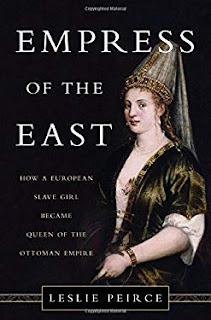
Leslie Peirce's EMPRESS OF THE EAST has to be the most interesting book I've read in a long time. On the new book shelf at my local library, I had no idea the book would be about Ruthenia, Hungary under the Ottoman Turks, the Austrian Empire and slavery, until I started reading! This one was a page-turner for me. It should be of interest to anyone who wants to know more about the history of Hungary, Poland, Ukraine, Ruthenia, and Europe.At about the age of 13, Roxelana was captured in Ukraine - Ruthenia along with thousands of others who were marched a long distance to live out their lives under Ottoman Rule. These slaver-raids took hundreds of thousands of people into Turk territory. As with the images we have of African slaves, they were barefoot, in chains, and lucky to survive the journey.
While not every slave was used in the harem, those slave women who were selected to live in it were there for a purpose and that was not exactly sexual pleasure. Rather the Turks had a social system that was dependent on slaves not just for labor but for the reproduction of Princes. Once selected she would be bred and this would continue until she had a son. At that point the woman would become a Prince's mother and devote her life to his education. Some of the women competed to be chosen, to survive, and then competed for their sons to be given important tasks.
Having left marriage for Princes behind, the idea was for every Prince to have as many sons as possible. Being pragmatic, there was so much death due to illnesses and plagues that this might have been a reproduction strategy. It was also, however, a means of keeping the ever-expanding empire in control because a Prince who reached the age of adulthood, which was about fifteen years old, could be assigned to rule a particular province of the newly expanded empire. The Turks were expanding their empire violently, but slavery had many ethnicities collaborative in the abduction, sale, transfer, and so on of slaves including Jews, Armenians, and Italians. Slave men were sometimes made to soldier. Each slave was converted to Islam and enculturated to be a Turk.
For those who see DNA as a way to determine ethnicity, the book convinced me that there is a great deal of Hungarian and Slavic DNA within those with a certain, shall we say noble, Turkish heritage.
The book doesn't go into the military aspects but we know that about two thirds of the Hungarian people were massacred and the country was destroyed due to this expansionism. It is strong in showing just how exceptional this slave girl was, as she rose in the haram not only to be a favorite, but that she actually married her Prince, the very man who was responsible for much of the massacre of the Hungarian people centuries ago.
Suleyman The Great was often away for months or years at a time with his campaigns into Hungary but he wrote Roxelana, called Hurrem, love poetry and she showed her faithfulness in writing him many impassioned letters. He married her and he certainly went against tradition by doing so. They became a nuclear family with several children. Suleyman's own mother had also been a slave girl and so he was possibly half Polish!
I was reminded that ETHNICITY IS ACQUIRED and not just about your DNA.
Roxelana became a famous person as she used her power as a philanthropist and was behind the building of mosques, schools, hospitals, and as an administrator over the haram, marriages for many of the women who lived there. She was reported on to all the noble houses of Europe as everyone wanted to know who who was and in power all the time. She lived with all the riches available to a person on her rank.
Another aspect of this book is that it is about the Moslem Religion and the changing attitudes about women. Prior to her rise, women had apparently been allowed power and had been allowed to be seen. Then, perhaps as a means of protection both men and women of high, royal rank began to seclude themselves. Though insiders dealt with Roxelana, and her influence and good works were well known beyond the Ottoman Empire, when she traveled in a train of carriages, the wealth was on show but no one got to see her face. Women of high rank became more and more restricted in their lives and their exposure to the world outside their own homes, something that has, in my opinion, gone into the extreme repression of females in many Moslem societies today.
Those of us alive today with Hungarian genetic heritage are survivors of survivors and some of us may also carry the DNA of rapists who killed entire families, entire villages of people.
All very thought provoking.
C 2022 Magyar-American BlogSpot
Mentioned in this book 1540 John Zapolya, King of Hungary and Governor of Transylvania.
1542 Queen Isabella, the eldest child of Sigismund I the Old, King of Poland and Grand Duke of Lithuania. Her mother was Bona Sforza of Milan, Italy. Ferdinand, the archduke of Austria in control of Western Hungary who occupied Buda but was expelled by Suleyman.