Showing posts with label Ruthenians. Show all posts

Saturday, April 9, 2022

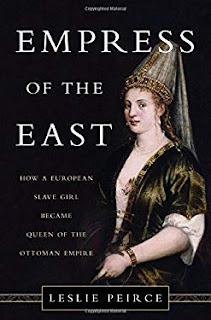
EMPRESS OF THE EAST by LESLIE PEIRCE : MAGYAR- AMERICAN BOOK REVIEW


Leslie Peirce's EMPRESS OF THE EAST has to be the most interesting book I've read in a long time.  On the new book shelf at my local library, I had no idea the book would be about Ruthenia, Hungary under the Ottoman Turks, the Austrian Empire and slavery, until I started reading!  This one was a page-turner for me. It should be of interest to anyone who wants to know more about the history of Hungary, Poland, Ukraine, Ruthenia, and Europe.

At about the age of 13, Roxelana was captured in Ukraine - Ruthenia along with thousands of others who were marched a long distance to live out their lives under Ottoman Rule. These slaver-raids took hundreds of thousands of people into Turk territory. As with the images we have of African slaves, they were barefoot, in chains, and lucky to survive the journey.

While not every slave was used in the harem, those slave women who were selected to live in it were there for a purpose and that was not exactly sexual pleasure.  Rather the Turks had a social system that was dependent on slaves not just for labor but for the reproduction of Princes. Once selected she would be bred and this would continue until she had a son. At that point the woman would become a Prince's mother and devote her life to his education.  Some of the women competed to be chosen, to survive, and then competed for their sons to be given important tasks.

Having left marriage for Princes behind, the idea was for every Prince to have as many sons as possible.  Being pragmatic, there was so much death due to illnesses and plagues that this might have been a reproduction strategy.  It was also, however, a means of keeping the ever-expanding empire in control because a Prince who reached the age of adulthood, which was about fifteen years old, could be assigned to rule a particular province of the newly expanded empire. The Turks were expanding their empire violently, but slavery had many ethnicities collaborative in the abduction, sale, transfer, and so on of slaves including Jews, Armenians, and Italians. Slave men were sometimes made to soldier.  Each slave was converted to Islam and enculturated to be a Turk. 

For those who see DNA as a way to determine ethnicity, the book convinced me that there is a great deal of Hungarian and Slavic DNA within those with a certain, shall we say noble, Turkish heritage.  

The book doesn't go into the military aspects but we know that about two thirds of the Hungarian people were massacred and the country was destroyed due to this expansionism.  It is strong in showing just how exceptional this slave girl was, as she rose in the haram not only to be a favorite, but that she actually married her Prince, the very man who was responsible for much of the massacre of the Hungarian people centuries ago.  

Suleyman The Great was often away for months or years at a time with his campaigns into Hungary but he wrote Roxelana, called Hurrem, love poetry and she showed her faithfulness in writing him many impassioned letters.  He married her and he certainly went against tradition by doing so. They became a nuclear family with several children. Suleyman's own mother had also been a slave girl and so he was possibly half Polish! 

I was reminded that ETHNICITY IS ACQUIRED and not just about your DNA. 

Roxelana became a famous person as she used her power as a philanthropist and was behind the building of mosques, schools, hospitals, and as an administrator over the haram, marriages for many of the women who lived there.  She was reported on to all the noble houses of Europe as everyone wanted to know who who was and in power all the time.  She lived with all the riches available to a person on her rank.

Another aspect of this book is that it is about the Moslem Religion and the changing attitudes about women.  Prior to her rise, women had apparently been allowed power and had been allowed to be seen. Then, perhaps as a means of protection both men and women of high, royal rank began to seclude themselves.  Though insiders dealt with Roxelana, and her influence and good works were well known beyond the Ottoman Empire, when she traveled in a train of carriages, the wealth was on show but no one got to see her face. Women of high rank became more and more restricted in their lives and their exposure to the world outside their own homes, something that has, in my opinion, gone into the extreme repression of females in many Moslem societies today.

Those of us alive today with Hungarian genetic heritage are survivors of survivors  and some of us may also carry the DNA of rapists who killed entire families, entire villages of people.

All very thought provoking.

C 2022 Magyar-American BlogSpot

Mentioned in this book  1540 John Zapolya, King of Hungary and Governor of Transylvania.

1542 Queen Isabella, the eldest child of Sigismund I the Old, King of Poland and Grand Duke of Lithuania. Her mother was Bona Sforza of Milan, Italy. Ferdinand, the archduke of Austria in control of Western Hungary who occupied Buda but was expelled by Suleyman.


Wednesday, February 2, 2022

UKRAINE : AN ILLUSTRATED HISTORY by PAUL ROBERT MAGOCSI : MAGYAR AMERICAN BOOK REVIEW


C 2007 University Toronto Press

I enjoyed this book, which probably needs another chapter or two, because of what has been happening in recent events with the possibility Russia will invade Ukraine and various countries - NATO - offering resistance of some sort. I thought the author did a good job of being unbiased, using population statistics, and taking us through events through history including border changes and so on.  Reading this book helped me better understand just how complicated it has been. Maps and photos are so helpful.  What impressed me is how passionate people have been about the politics and economic aspects of life in this part of the world and how violent it has been.

Like Hungarians in Romania, there is a sizeable population of ethnic Russians in Ukraine. It seems there long been various ethnicities, from tribal days forward, in this land. 

Still, it is my not so humble opinion that the real reason Russia wants the Ukraine is not just to expand its already sizeable turf or because it wants its borders to be up against many a European nation. I think it is because the Ukraine has fertile farmland and poverty and that it is a 'breadbasket' that can feed people and with the possibility of low wage agricultural workers.  In the United States a 'breadbasket' can be a place like the central valley of California where the low wage workers are migrants, often from Mexico.

If I were someone who could influence Russia - Putin - I would say to him that Russia has the opportunity to create new cities and use new technologies for the benefit of people there and can lead the way towards new forward thinking culture and society - there in the country they already have - and that is where they should put resources rather than military actions. I realize that much of Russia is considered too difficult because of the weather to easily sustain people at this point, but I think this is possible.  Who knows?  If Global warming is the continuing trend this cold place may become most desireable.

I wonder how many people self-identify as solely Ukrainian these days.

The history of this area of the word includes the Greeks and the Scythians, the Khazars anbd the Kievan Rus, the Mongols and the Tartars, and just about every kind of Slavic ethnicity.

In this book you will be guided with knowledge of what was Ukraine during the Austrian Empire of 1772-1815, in 1875 Austria-Hungary, after World War I including the West Ukrainian National Republic. Soviet Ukraine of 1932, lands in Poland circa 1930, what the situation is with Rusyn (Ruthenian) people living in Romania and Czechoslovakia in 1930, Carpatho-Ukraine in the World War II era of 1939-1941, and Soviet Ukraine in 1945.

I wish for peace.

C 2022 Magyar-American BlogSpot


Saturday, March 20, 2021

NATIONAL CARPATHO-RUSYN CULTURAL CENTER

 National Carpatho-Rusyn Cultural Center

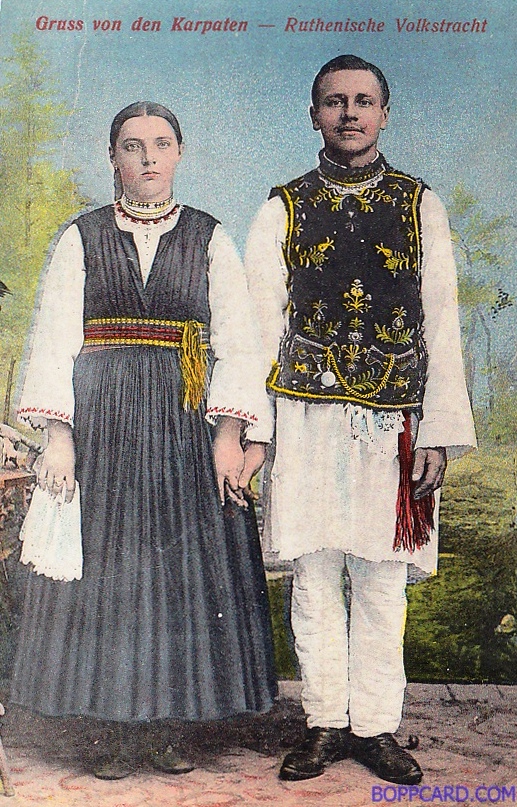
There are a number of ways that people who lived in the Carpathian Mountains as a separate, East Slavic ethnicity are identified. Rusyn or Ruthenian, Greek Catholic, erroneously Russian. Within their ethnicity there are the Lemkos, the Boykos, and the Hutsels. A great number of Rusyn villages were and are in Hungary. Generally in the mountains of Slovakia, Belorus, and Ukraine, these people have not had a nation to call their own. Some intermarried or assimilated to the nation they found themselves living in.

The Spis area had some Rusyn habitations.

I've been checking on what's new with the people in a place called Munhall near Pittsburgh who started this organization a few years ago and learned they went National with about 1800 members. They have a number of information YouTube videos as well. If you or family members are Greek Catholic or Byzantine, and you find your surname on the list, you may share some Rusyn in your Hungarian Heritage. Listening to the short lecture by Mr. Rigatti, I learned that the Hungarian land Barons and Slovaks let the Rusyn people live their culture. Then things changed.


Monday, July 22, 2019

MASSIVE UKRAINIAN GENEALOGY DATABASE UP AND RUNNING - 1650 - 1920 BIRTHS

Originally published on the MAGYAR-AMERICAN blog on July 22 2019

Special note November 2018. Some parts of Historic Hungary are now in Ukraine. Ukrainians also lived in Hungary.

Image result for public domain free download vintage ukrainian

Those of you who have been in the United States for a couple generations at least may be only partly Hungarian / Magyar.  Your family may also have origins in Slovakia, Poland, Yugoslavia, or Ukraine as well. Yes, we intermarried with our "own" people : people who shared a religion or the experience of Central and Eastern Europe. Those of you who remember grandparents or great-grandparents who lived in ethnic ghettos of immigrants before the family started moving out to the suburbs may remember hearing so many languages spoken when you went to visit. You might also be part RUTHENIAN, of the mountain people who lived in the Carpathians in what became four different countries. Close to 4 MILLION people in the database born between 1650  and 1920  - rush to the site and see the possibilities.


A wealthy man who instigated his own genealogy research and believes the ancestors remain with us so long as we remember their names, Igor Howszowski, is responsible.


LINK TO THE DATABASE UKRAINIAN GENEALOGY DATABASE - PRA.IN.UA

Friday, February 3, 2012

HUNGARIANS ARE ALL GERMANS : STEREOTYPES OF HUNGARIANS / HUNGARIAN AMERICANS


Is anyone a "pure" or "unmixed" Hungarian?

I'm not going to indulge in anything close to Nazism here. I'm not looking to eliminate anyone who identifies as Hungarian as not because over generations their Hungarians have mixed with Germans, Slovaks, Ruthenians, or Jews, or anyone in particular.

When it comes to stereotypes of Hungarians though, it seems that this "truism" is often repeated. Sometimes when I hear it coming out of someone's mouth I get the feeling they are being DISMISSIVE of a unique culture, that they even have forgiveness for Hungarians because "really" they are Germans.

Have you had this experience?


(Run the word "stereotype" through the search feature on this Google Blogger to bring up OTHER STEREOTYPES.)

C 2012 Magyar-American BlogSpot