Showing posts with label Industrial Revolution. Show all posts

Saturday, September 5, 2020

THE JOHNSTOWN FLOOD : MAGYAR AMERICAN FILM REVIEW

This wonderful documentary made by Joker Films, with Richard Dreyfuss as the narrator, is full of photos, art inspired by the devastating Johnstown flood of 1889, film!, and enacted testimonials sourced from books and letters - all in black and white.

This review is here at Magyar American - BlogSpot because the Johnstown, Cambria County, Pennsylvania area, especially the Cambria Iron Works, was the destination and workplace of so many immigrants from central and eastern Europe, including Magyars, Slavs, and Ruthenians.

Over 2000 people died. Poor people, who didn't know what hit them as the flood waters took them away, to be struck by logs and trees, floating houses ripped from their foundations, detached roofs, factories, and locomotives, lost their lives in minutes.  Some people floated on debris a while, praying or singing hymns. A memorial cemetery, the Grandview, in Johnstown is the higher burial ground of many who were never identified.

The Johnstown Flood (1926)

The Conemaugh Valley was the home to 30,000 people and it was a bustling place to live and work. The Fishing Club upriver was the exclusive social club for men like Andrew Carnegie and Henry Clay Phipps, people you may have heard of as Robber Barons or the founders of Pittsburgh institutions such as the Carnegie Library, Carnegie-Mellon the university, or the Phipps Conservatory, owners of steel mills. The Pennsylvania Railroad ran trains all around Pennsylvania, and from Johnstown to Pittsburgh there were trains that ran like commuters - The Daily Express.  One of my ancestors took this train for work in Allegheny Country before moving the family there from Johnstown.

The South Fork dam was built years earlier in 1852 of clay and earth and the lake filled with more water and was more vast than had been expected so maybe it was just a matter of time. Heavy rains pushed it to the limit and when it broke, there was near no escaping the violence of rushing waters.  Cambria Iron Works was wiped out. Then caught fire. The train roundhouse and the trains in it were carried away though each weighted many tons.

The people had been warned.  Men on horseback had ridden through town shouting warnings.  These warning were ignored. Trains blew whistles and still, many people stayed put.  Commuters got off trains that had been waylaid and ran for the hills.  Entire towns were wiped out in Conemaugh Valley.  Eventually Clara Barton who founded the Red Cross made a personal visit to the disaster site and it became the law to shoot and kill looters, who were cutting fingers off the dead to take the rings.

I sat glued to my seat watching this one, and I think you might too, especially if the Johnstown area was the destination of your immigrant ancestors.

C 2020 Magyar American BlogSpot
All Rights Reserved.

Tuesday, August 5, 2014

CARNEGIE LIBRARY BRADDOCK PENNSYLVANIA - THE FIRST CARNEGIE LIBRARY EVER - NEEDS MONEY FOR REFURBISHING!

A couple weeks back I called this library to see what, if anything, they had that might help me with my genealogy project and learned that the CARNEGIE LIBRARY in OAKLAND (near the Universities like Pitt and Carnegie Mellon) is the place to go.

I got to talking to a sweet librarian and she told me about the librarians there, who clearly take pride in the place their branch has in history, especially the history of the INDUSTRIAL REVOLUTION,  and a campaign they have going to refurbish it.

BRADDOCK CARNEGIE LIBRARY START PAGE


A NATIONAL HISTORICAL LANDMARK HISTORY OF BRADDOCK CARNEGIE LIBRARY

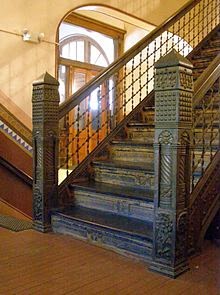
"The Braddock Carnegie Library in Braddock, Pennsylvania, is the first Carnegie Library in the United States. Designed by William Halsey Wood in eclectic medieval style, it was built in 1888 and dedicated by Andrew Carnegie on March 30, 1889. An addition in more Richardson Romanesque style by Longfellow, Alden & Harlow (successors to HH Richardson) was added in 1893. The library was named a National Historic Landmark in 2012, following its listing on the National Register of Historic Places in 1973, and is on the Pittsburgh History and Landmarks Foundation’s List of Historic Landmarks."


Picture from Wikipedia

1889 staircase...  Did your immigrant great grandpa climb these steps as a school boy with a book in his hand while his father slaved doing double back shifts in the mill?


CALL THIS NUMBER TO DONATE A LITTLE OR A LOT!  412-351-5356
Tell them "Magyar American sent you!"

Wednesday, November 13, 2013

THEY'RE ALL MILL HUNKS : STEREOTYPE OF HUNGARIAN - AMERICANS


This stereotype comes from the Industrial Revolution, the early 20th century, and the immigration of so many Hungarians who were leaving rural areas and rural work for the next new thing - factories. 

Of course, for the people, mostly men, who had been master craftsmen in Hungary, this wasn't too much of a change, because they had performed hard physical labor and were hands-on and detail oriented before they left the country.  As many family story goes, they were sold on the idea that the streets here were paved with Gold, thought they would make some money and go back to Hungary, and many of these men did go back and forth to Hungary, working home farms and wineries in season. Some came to the United States after working in manufacturing, including steel making, and had technical educations in Hungary before they came to the United States.

However, there were Hungarians in early colonial America - some - and there were Hungarians who marched with Freemont when he came to California to claim it for the United States. 

Hungarians who spoke German, and that was the language they went to school in once Maria Theresa instituted public education during the time when Hungary was part of the Austrian empire, could find work where Germans also worked. This was true in Texas and in New Jersey. Perhaps it's the prevailing settlement pattern.

There is nothing negative about hard work and enterprise, it's the notion that many other Americans had and still hold in some cases that the MILL HUNK is NOT INTELLIGENT.  Despite the fact that factories required SKILLED LABOR, and that the working conditions were killing - split shifts and six day work weeks for starters - pollution and heat as well - and these men labored without the representation of Unions for some time - some people simply want to believe that others are less than them somehow.

These days the manufacturing that once was has left America. The Steel Belt became the Rust Belt long ago when the steel making was sent to Japan. Many sons and grandsons of MILL HUNKS have found themselves following the next new thing - computer technology.  Some remain Blue Collar Workers while others have chosen college educations and white collar careers.

Be it that he's wearing a muscle shirt or is suited up, these men "clean up nice."

We are thankful to be here because of them.

C Magyar American 2013  All Rights Reserved